

The Workplace Reimagined: Five Forces Reshaping Multi-Site Organisations in 2026
From Space to System.
For much of the past two decades, workplace strategy has been treated as a question of space - how much is needed, where it should be located, and how efficiently it can be delivered. That framing is no longer sufficient.
Across global markets, organisations are confronting a more fundamental shift: the workplace is no longer a static asset but a dynamic system - one that must respond to changing patterns of work, evolving employee expectations, and increasing financial scrutiny. For multi-site occupiers in particular, this transformation is not incremental. It is structural.
The organisations that are navigating this shift most effectively are not simply redesigning offices. They are redefining the role of the workplace within their business model - aligning real estate, people strategy, technology, and operational delivery into a single, coherent system. This is where competitive advantage is now being shaped.
At DBW, we are seeing this transition play out across portfolios, sectors, and geographies. While each organisation faces its own context, a consistent set of forces is emerging - forces that are reshaping how workplace decisions are made and how value is created.
Five of these forces are defining the next phase of workplace transformation.

1. The Shift from Attendance to Purpose
The debate around “return to the office” has largely been resolved - not by policy, but by behaviour.
Employees are no longer motivated by presence alone. They are motivated by purpose. The question is no longer whether people come to the workplace, but why.
In high-performing organisations, the workplace has become a destination for specific outcomes: collaboration, innovation, cultural alignment, and decision-making. Activities that require focus or individual productivity are increasingly distributed, enabled by digital infrastructure rather than physical proximity. This shift has profound implications for workplace design and strategy.
Spaces must now be curated around moments that matter. Collaboration zones, social environments, and spaces for structured interaction take precedence over traditional desk-based layouts. The emphasis moves from density to experience, from utilisation to effectiveness.
For multi-site occupiers, this also introduces a need for clarity across the portfolio. Each location must have a defined role - whether as a hub for collaboration, a centre of excellence, or a regional anchor. Without this clarity, workplaces risk becoming interchangeable and underutilised.
The organisations that succeed are those that design their workplaces around intent, not assumption.
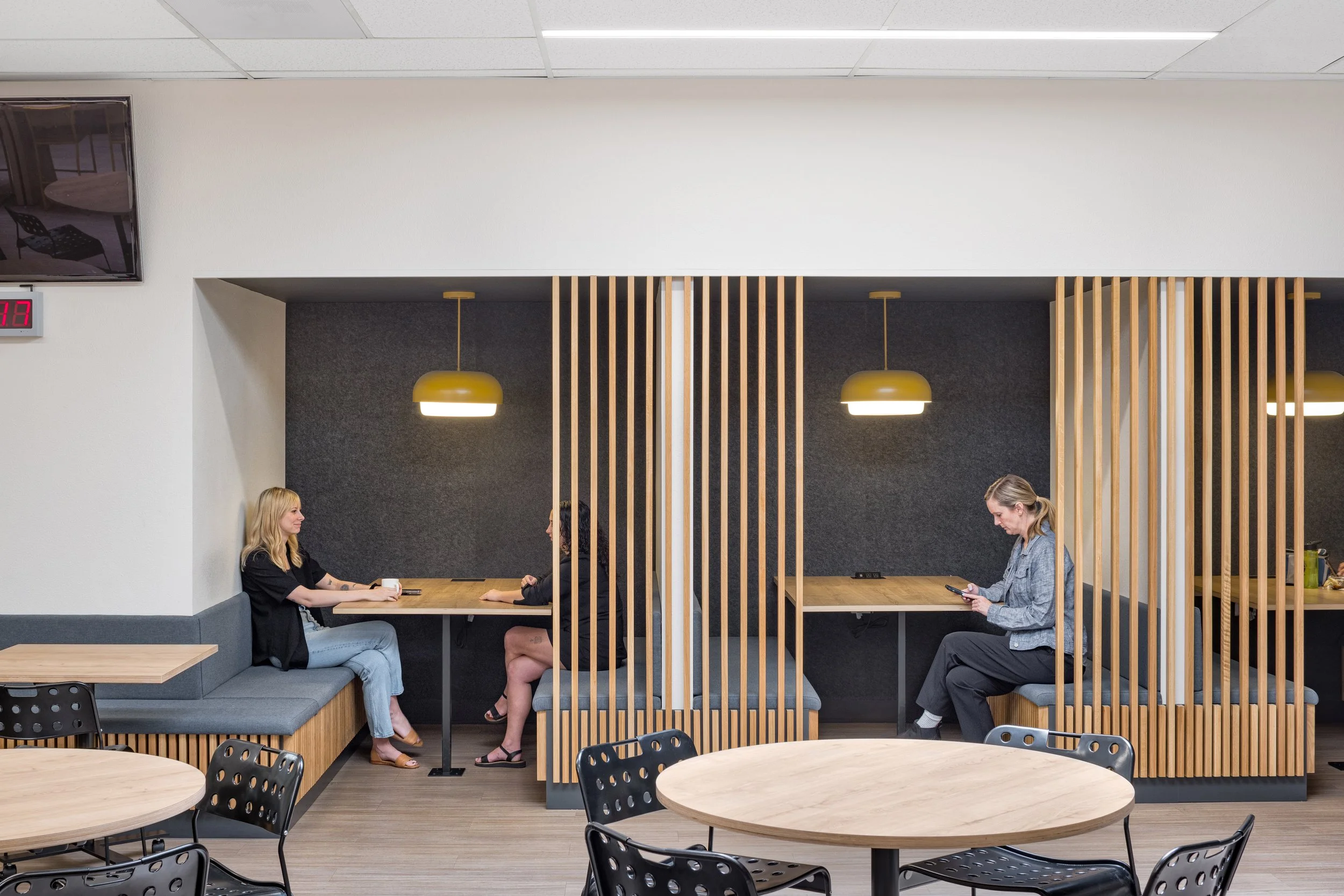
2. Portfolio Rationalisation and the Rise of the Networked Workplace.
The second force reshaping the workplace is the reconfiguration of real estate portfolios.
For many organisations, the legacy portfolio was built for a different era - one defined by predictable patterns of attendance and long-term stability. Today, those assumptions no longer hold.
Demand for space has become more fluid. Teams are more distributed. Business priorities shift more rapidly. As a result, the traditional model of large, static offices is being replaced by a more agile, networked approach.
This does not necessarily mean reducing footprint - although in some cases, that is part of the strategy. More often, it means reallocating investment: consolidating where appropriate, enhancing key locations, and introducing flexibility into the system.
The concept of the “hub-and-spoke” model has gained traction, but in practice, the most effective portfolios are more nuanced. They are designed as ecosystems - combinations of flagship offices, regional hubs, flexible spaces, and third-party solutions that together support a range of work patterns. Crucially, this shift requires a different approach to decision-making.
Portfolio strategy can no longer be driven solely by cost per square foot. It must consider factors such as talent access, employee experience, operational resilience, and long-term adaptability. This introduces a level of complexity that demands both strategic clarity and disciplined execution.
For organisations with multiple locations, the opportunity lies in treating the portfolio as a connected system - one that can be optimised continuously, rather than reconfigured periodically.
3. Experience as a Driver of Performance
The third force is the elevation of workplace experience from a “nice to have” to a core business driver.
In an environment where talent is both mobile and selective, the quality of the workplace experience has become a differentiator. It influences not only attraction and retention, but also engagement, collaboration, and ultimately performance. However, experience in this context extends beyond aesthetics.
It encompasses the entire journey of the employee: how they access the workplace, how they interact within it, how easily they can collaborate, and how supported they feel in performing their role. It includes environmental factors such as light, acoustics, and air quality, as well as digital integration and service provision.
For multi-site organisations, consistency becomes a critical challenge.
Employees increasingly expect a seamless experience across locations. Disparities between sites - whether in design quality, technology, or service levels - can undermine both productivity and perception.
Addressing this requires a more holistic approach to workplace strategy - one that integrates design, technology, and operations into a unified experience framework.
At DBW, we see the most effective organisations treating workplace experience as a measurable output. They define what “good” looks like, align their delivery teams around that definition, and continuously refine it based on feedback and data.
In doing so, they move beyond design as an isolated discipline and position the workplace as a platform for performance.
4. Data-Led Decision Making and the End of Assumption.
Historically, workplace decisions have often been guided by precedent and intuition. In today’s environment, that approach is no longer viable. The fourth force shaping the workplace is the increasing reliance on data to inform strategy, design, and delivery.
Advances in workplace analytics now allow organisations to understand how spaces are used, how teams interact, and where inefficiencies exist. This data provides a level of insight that was previously unavailable, enabling more informed and more confident decision-making.
However, the value of data lies not in its collection, but in its application.
Leading organisations are using data to challenge assumptions, test hypotheses, and refine their strategies over time. They are moving towards a model of continuous optimisation - where workplace performance is monitored and adjusted in response to real-world behaviour.
For multi-site portfolios, this capability is particularly powerful. It allows organisations to compare performance across locations, identify patterns, and make targeted interventions. It also supports more dynamic planning - enabling organisations to respond quickly to changes in demand or business priorities.
Importantly, this shift also changes the role of the workplace advisor.
The expectation is no longer to provide a static solution, but to act as a strategic partner - one who can interpret data, provide insight, and guide decision-making over time.
5. Delivery Certainty in an Increasingly Complex Environment.
The final force is perhaps less visible, but no less critical: the growing complexity of delivering workplace transformation.
As organisations place greater strategic importance on their workplaces, the expectations around delivery have increased. Projects must not only meet design aspirations, but also align with business timelines, financial constraints, and operational requirements.
At the same time, the delivery environment itself has become more challenging.
Supply chains remain volatile. Construction costs are subject to fluctuation. Regulatory requirements continue to evolve. For multi-site programmes, these challenges are compounded by scale and coordination. In this context, delivery is no longer a downstream activity. It is a strategic capability.
Organisations that succeed are those that integrate delivery thinking from the outset - aligning strategy, design, and construction into a single, cohesive process. They prioritise programme certainty, cost transparency, and risk management, ensuring that decisions made in the early stages are carried through to completion.
This is where experience and structure become critical.
A well-defined delivery framework - supported by clear governance, robust processes, and experienced teams - provides the foundation for consistent outcomes across a portfolio. It allows organisations to scale their ambitions without compromising on quality or control.
Conclusion: From Projects to Platforms.
Taken together, these forces point to a fundamental shift in how the workplace is conceived and delivered.
The workplace is no longer a series of projects. It is a platform - one that supports organisational performance, enables cultural alignment, and adapts to changing conditions over time.
For multi-site occupiers, this shift presents both a challenge and an opportunity.
The challenge lies in navigating complexity - aligning multiple stakeholders, managing diverse portfolios, and delivering consistent outcomes at scale. The opportunity lies in unlocking value - creating workplaces that not only support the business, but actively contribute to its success.
At DBW, our role is to bring clarity to this complexity.
Through the integration of strategy, design, pre-construction, and delivery, we help organisations define their workplace vision and translate it into reality - consistently, efficiently, and with purpose.
Because in today’s environment, the workplace is no longer just where work happens. It is how organisations perform.