
The AI-Enabled Workplace: How Artificial Intelligence Will Reshape Workplace Design Over the Next 24 Months
Introduction: From Concept to Immediate Reality
For much of the past decade, artificial intelligence has been discussed as a future disruptor of work.
In 2026, that future has arrived - unevenly, but decisively.
AI is no longer confined to experimentation or niche applications. It is actively reshaping how knowledge work is performed across sectors. Tasks that once required hours are being completed in minutes. Decision-making is being supported by real-time analysis. Content creation, research, and coordination are increasingly augmented by intelligent systems.
What is less widely understood is the speed at which this shift will begin to influence the workplace itself.
Over the next 24 months, AI will not simply change how people work.
It will change what the workplace is for.
For multi-state organizations, this represents both an opportunity and a risk. The environments being designed today must account not only for current patterns of work, but for behaviors that are already beginning to evolve.
Those that fail to do so will find themselves delivering workplaces that are outdated almost as soon as they are occupied.
The Immediate Impact: Reducing the Need for Space, Increasing the Need for Interaction
One of the most immediate effects of AI is its impact on individual productivity.
Tasks that once required focused, solitary effort—drafting, analysis, research—are increasingly being supported or accelerated by AI tools. As a result, the time required for certain types of work is reducing.
This has a direct implication for workplace design.
The demand for space dedicated to individual, task-based work is likely to decline further. Not because this work disappears, but because it becomes more efficient and more easily conducted outside the office.
At the same time, the relative importance of interaction increases.
As routine tasks are automated or augmented, the activities that remain most valuable are those that require human input:
Complex decision-making
Creative problem-solving
Relationship-building
Strategic alignment
These activities benefit disproportionately from in-person interaction.
The workplace therefore becomes more focused.
Less a place for doing work in isolation, and more a platform for high-value collaboration.
For multi-site organizations, this shift reinforces the need to define the role of each location within the portfolio - ensuring that environments are designed to support interaction, not just occupation.
The Rebalancing of Space: From Desks to Dynamic Environments
Over the next 24 months, one of the most visible impacts of AI on workplace design will be the rebalancing of space.
Traditional desk-based layouts—already under pressure from hybrid working—will continue to decline in relevance.
In their place, organizations will increase provision for:
Collaboration environments
Project-based working areas
Flexible team zones
Spaces that support rapid interaction and iteration
However, this is not simply a matter of increasing the number of meeting rooms or informal areas.
The nature of these spaces must also evolve.
AI-enabled work is often faster, more iterative, and more dynamic. Teams may need to convene quickly, align on insights generated by AI tools, and make decisions in shorter cycles.
This requires environments that support:
Speed of interaction
Ease of access
Flexibility of use
Spaces must be easily reconfigurable. Technology must be seamlessly integrated. Friction must be minimized.
For multi-state portfolios, achieving this consistently across locations becomes a critical challenge.
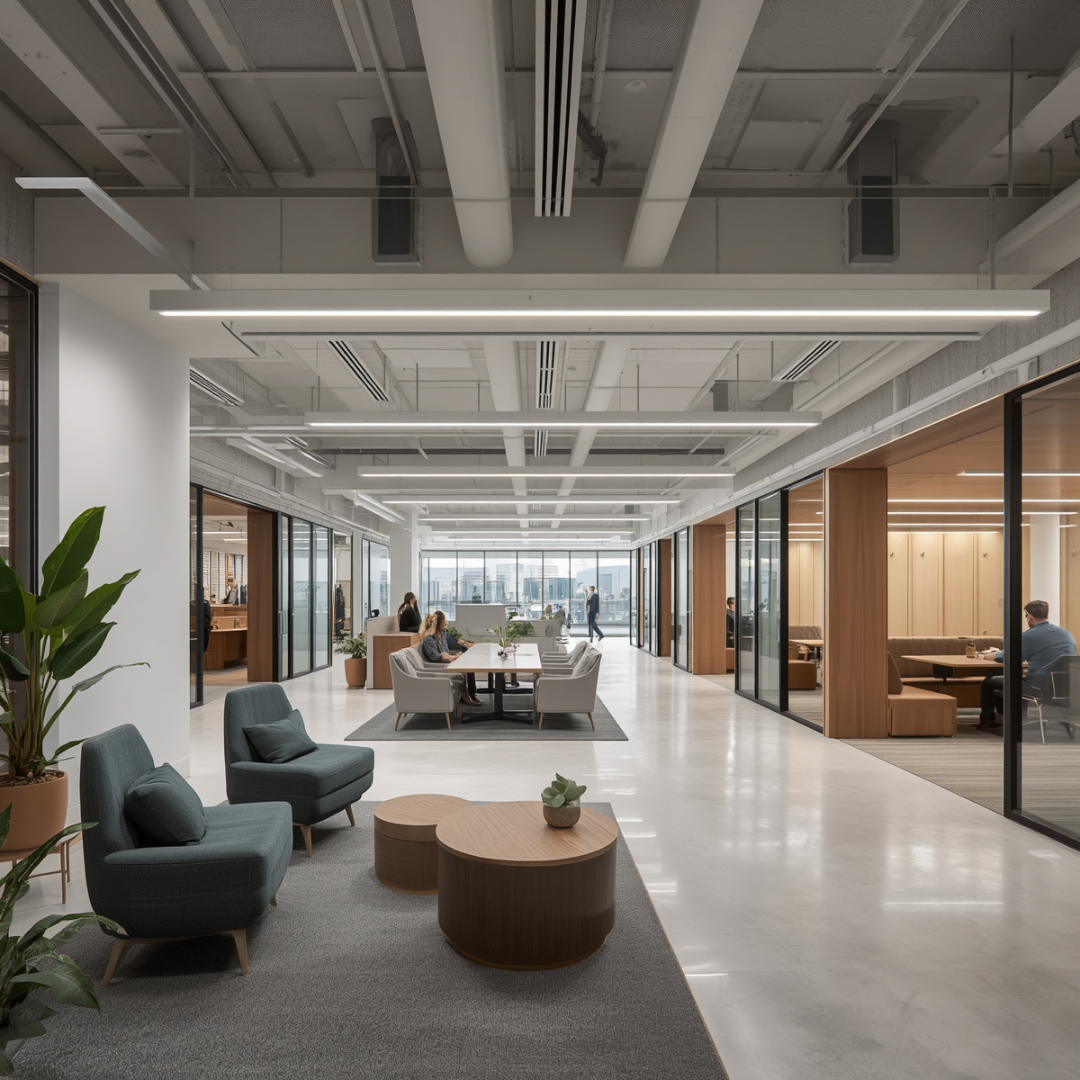
AI as a Design Tool: Accelerating and Enhancing Workplace Creation
AI is not only influencing how workplaces are used.
It is also changing how they are designed.
Design teams are beginning to use AI to:
Generate layout options based on defined parameters
Model different scenarios for space utilization
Analyze user behavior and predict future needs
Optimize adjacencies and spatial relationships
This introduces a new level of speed and sophistication into the design process.
Rather than relying solely on precedent or intuition, organizations can explore multiple design options quickly and assess their potential impact.
For clients, this creates an opportunity.
Workplace design becomes more iterative and data-informed. Decisions can be tested and refined before they are implemented.
However, it also introduces a risk. The availability of tools does not guarantee better outcomes. Without clear strategic direction, AI-generated solutions can become generic—optimized for efficiency, but lacking in alignment with organizational objectives.
The role of the advisor therefore becomes more important. Not simply to produce design, but to define the parameters within which AI is used.
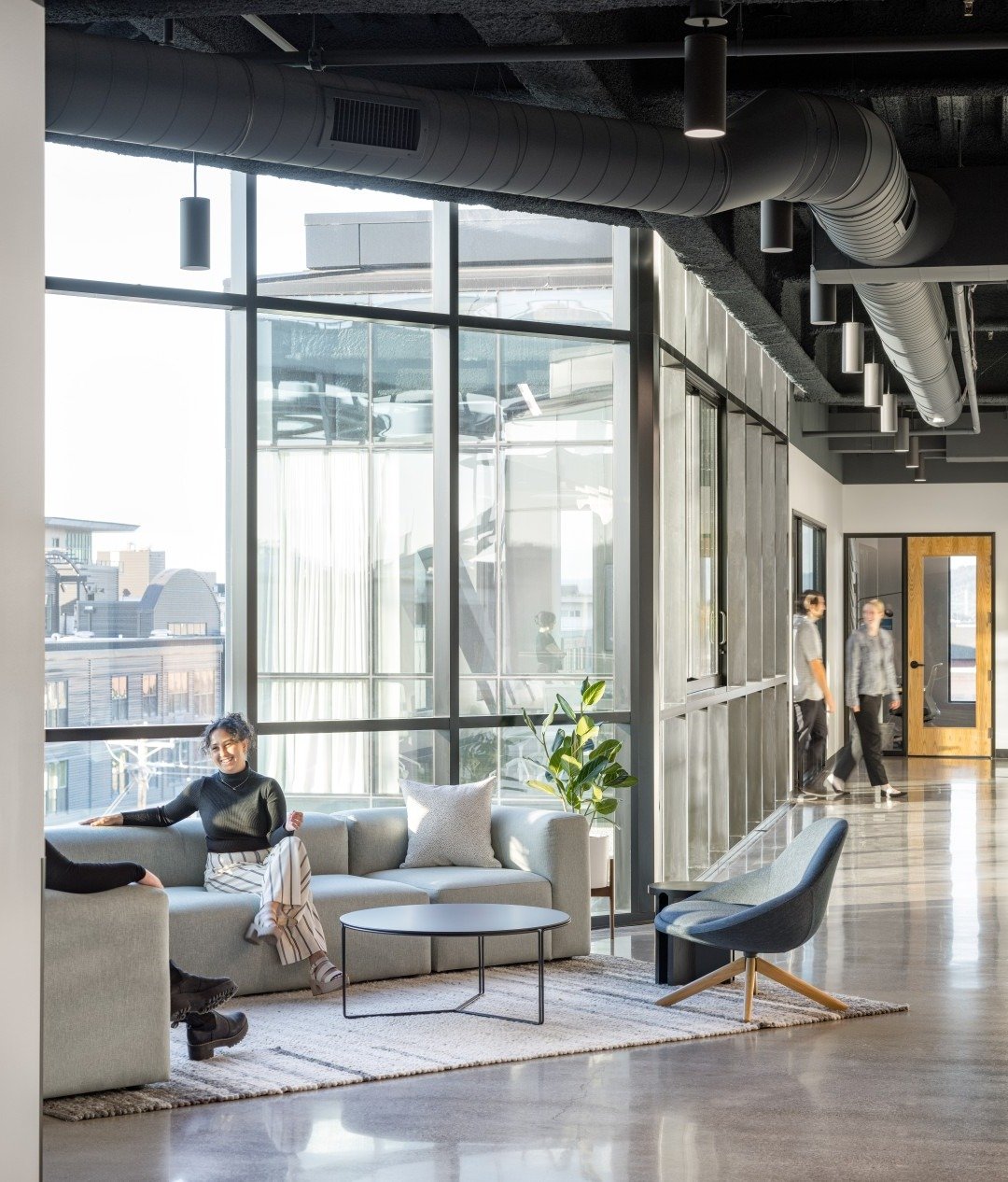
The Intelligent Workplace: Environments That Respond in Real Time
Beyond design, AI is beginning to influence how workplaces operate on a day-to-day basis.
Over the next 24 months, we are likely to see increased adoption of “intelligent workplace” systems—environments that respond dynamically to user behavior.
This may include:
Systems that adjust environmental conditions based on occupancy
Real-time space allocation based on demand
AI-driven scheduling and coordination tools
Predictive maintenance and operational optimization
These capabilities are enabled by the integration of sensors, data platforms, and AI algorithms.
The objective is to create environments that are more efficient, more responsive, and easier to use.
For employees, this reduces friction. Spaces are available when needed. Conditions are optimized automatically. Interaction with the workplace becomes more intuitive.
For organizations, it provides greater visibility and control. However, it also requires careful consideration.
Issues of data privacy, security, and user trust become more prominent. Systems must be designed in a way that balances capability with transparency.
The Changing Nature of Meetings and Collaboration
AI is already beginning to reshape how meetings are conducted.
Tools that summaries discussions, generate actions, and provide real-time insights are becoming more common. Hybrid meetings are being enhanced through better integration of in-person and remote participants.
Over the next 24 months, these developments will influence how collaboration spaces are designed.
Meeting rooms will need to support:
Seamless integration of AI tools
High-quality audio and visual interaction
Real-time access to information and insights
The distinction between physical and digital collaboration will continue to blur. Spaces must be designed to support both simultaneously. For multi-site organizations, this is particularly important.
Teams operating across locations must be able to collaborate effectively, regardless of where participants are based. The quality of interaction must be consistent across the network.
Talent Expectations: Working Alongside AI
As AI becomes more embedded in daily work, employee expectations will evolve.
Workers will increasingly expect environments that support their interaction with AI tools.
This includes:
Reliable connectivity
Access to appropriate technology
Spaces that support focused interaction with digital systems
Environments that enable collaboration around AI-generated insights
At the same time, there may be a counterbalancing effect. As work becomes more digitally mediated, the value of human interaction may increase. Employees may place greater importance on the social and cultural aspects of the workplace.
This creates a dual requirement. Workplaces must support both advanced digital interaction and meaningful human connection. Balancing these elements will be a defining challenge for organizations.
The Risk of Over-Correction
As organizations respond to the impact of AI, there is a risk of over-correction.
In seeking to accommodate new technologies and behaviors, they may move too far, too quickly - reducing space excessively or over-prioritizing certain types of environments.
This can create new inefficiencies. While AI will change how work is performed, it will not eliminate the need for physical environments. Nor will it standardize behavior.
Different roles, functions, and individuals will continue to have different requirements. The objective is not to design a workplace for AI. It is to design a workplace that enables people to perform effectively in an AI-enabled environment.
The Leadership Imperative: Acting Within the Window
The next 24 months represent a critical window.
Organizations are making decisions today that will shape their workplaces for the next five to ten years. At the same time, the impact of AI is accelerating.
This creates a tension. Delay carries risk, as environments become misaligned with evolving work patterns. Action, however, must be informed.
Leadership teams must therefore navigate this period with care.
They must ensure that workplace strategies are flexible enough to adapt, while being sufficiently defined to guide decision-making.
This requires:
Clarity of intent
Integration across functions
A willingness to challenge existing assumptions
For multi-state organizations, the scale of their portfolios means that these decisions have significant implications.
Conclusion: Designing for an AI-Enabled Reality
Artificial intelligence is not a distant influence on the workplace.
It is an immediate and accelerating force.
Over the next 24 months, its impact will be felt not only in how work is performed, but in how workplaces are designed, delivered, and operated.
For organizations, the challenge is not to predict every outcome. It is to design environments that can accommodate change.
This means moving away from static models and towards more adaptive systems. It means integrating technology into the core of workplace strategy. It means focusing on the activities that create the most value—and ensuring that the workplace supports them effectively.
At DBW, this is how we approach the next phase of workplace transformation.
Not by reacting to change, but by anticipating it—ensuring that the environments we create are not only aligned with today’s needs, but capable of evolving alongside the organizations they serve.
Because in an AI-enabled world, the workplace is not just where work happens. It is where human performance is amplified.